
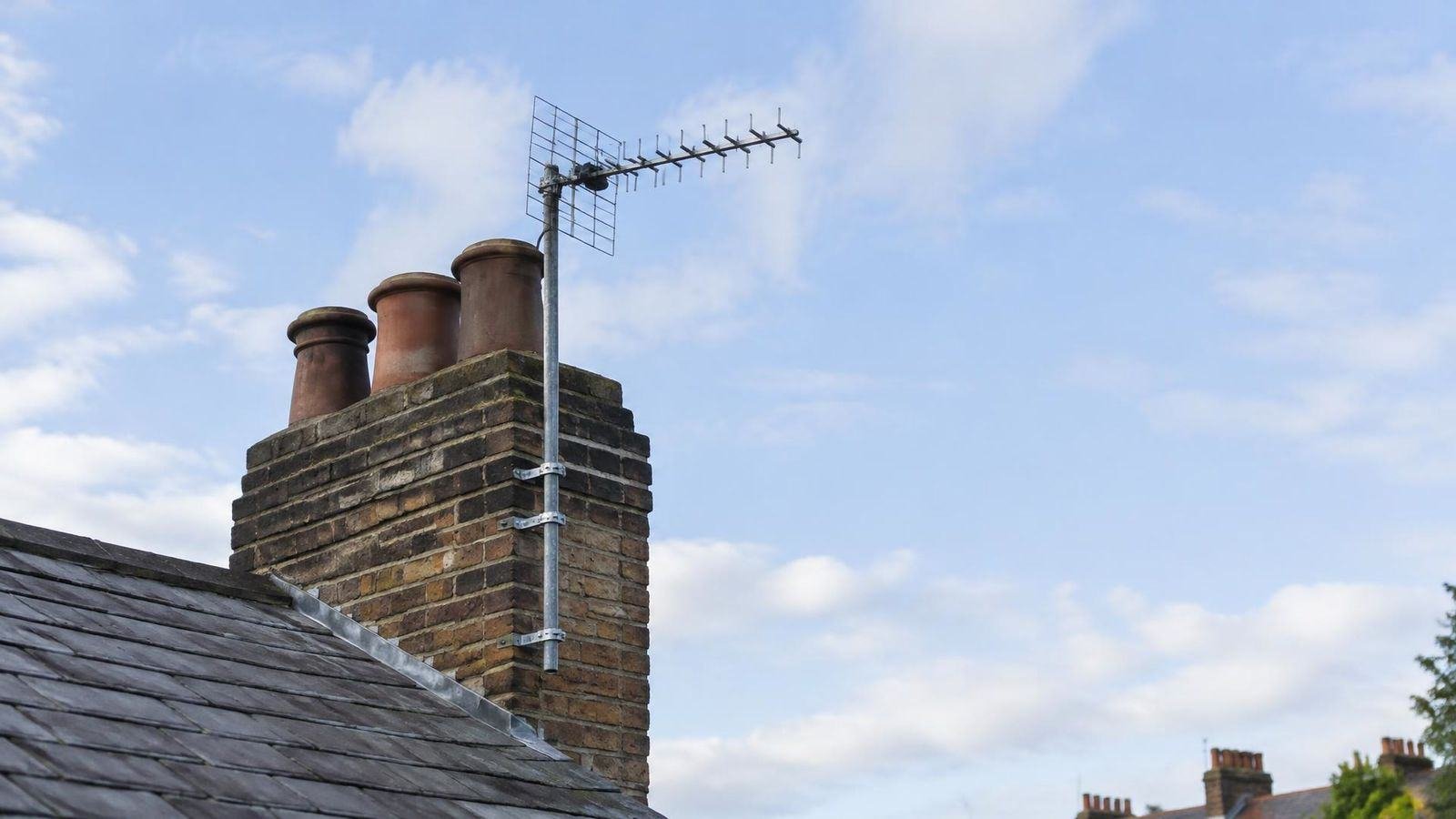
TV aerial installation in Hampton
TV aerial installation in Hampton for the 1980s and 1990s estate houses with no chimney, the semis along Hampton Hill, the older cottages in the village and the homes by the river. Each one needs a different fixing, and we choose the one that will last.
Aerial installation in Hampton: chimney, bracket or loft?
Plenty of Hampton houses have no chimney at all. Flip between the positions to see what the options look like.


- Picture you can rely on
- Out of sight
- Little to look after
Mounted on the rafters, out of the wind and rain. Roof tiles take some signal away, but where reception is good a loft aerial can work very well, and nobody outside ever sees it.
Choose it if: You’d rather not have anything on the roof, and our signal test in your loft comes out strong enough.
Bear in mind: Foil-backed insulation, solar panels or a metal roof can block it. We test before recommending one.
Ask which suits your home
Aerial fitter in Hampton for houses without a chimney
The Nurserylands estate and the other late twentieth-century developments in Hampton were built without chimneys, so the aerial has to go somewhere else.
- A bracket on the gable
- The end wall of the house is the natural spot. We fix a heavy T and K bracket into sound brick and set the mast high enough to clear the ridge.
- Facing the right way
- If the gable faces away from the transmitter, a cranked bracket or a mount under the eaves on the front or back wall gives the aerial a clear view.
- Covenants on the estate
- Some estates have rules about what goes on the street side. Where we can, the aerial sits on the flank or rear and the cable is clipped tight to the brick.
- Loft aerials under trusses
- These lofts are full of trussed rafters, and foil-backed insulation is common. We test before fitting there, as many of these roofs block too much signal.
Hampton aerial installation in the village and Hampton Hill
Around Thames Street, the old village and the High Street in Hampton Hill, older cottages and Victorian houses sit inside conservation areas.
Discreet on period chimneys
We fix to the back of the stack and keep the mast short, so the aerial is hard to see from the street.
Cable off the front
The downlead runs down the back of the house and into the loft, keeping it off frontages the council wants left alone.
Small chimneys on cottages
A cottage stack shared with next door has little room. We use a compact aerial and short mast on your side.
Fewer rooms, done properly
A cottage might need only the front room and the bedroom. We wire both neatly from a small amplifier or a quality splitter.
How an aerial installation in Hampton is done
A typical house takes half a day. A riverside property with a long cable run can take most of a day.
Testing at the fixing point
Before choosing the aerial we hold a meter at the bracket, stack or loft position, so the model suits your roof rather than a postcode guess.
Bracket and mast fitted
Wall brackets go into solid brick with stainless bolts, and chimney fixings use stainless lashing and corner plates.
Aerial aimed by meter
We turn the aerial slowly while watching the quality reading and lock it off at the peak.
Rooms wired and tuned
Cables run through the loft and down inside to flush sockets, and every TV is retuned and checked.
TV aerial installation for Hampton riverside homes
Houses along the Thames, and the homes and boats on the islands opposite, have their own reception quirks and their own access challenges.
Signal across the water
Water can reflect signal and cause the picture to break up. A more directional aerial, carefully aimed, rejects the reflections.
Island properties
Getting ladders and parts to an island home takes planning. We arrange access with you and bring everything we might need in one trip.
Damp riverside air
We seal every joint and use stainless fittings, as the damp near the river corrodes cheaper parts quickly.
Big riverside gardens
Garden rooms and boathouses at the bottom of long gardens can be fed with an outdoor cable run in conduit.
1930s semis in Hampton Hill and Hampton
Between the High Street and the park, many streets are interwar semis with hipped roofs, short stacks and, by now, a loft conversion or a big extension.
- Wall bracket under the eaves
- Where the stack is short or has been removed, a bracket high on the side wall lifts the aerial clear of neighbouring roofs.
- Loft conversions
- When the loft becomes a bedroom, the aerial and amplifier move out, usually onto the new gable or the side wall.
- Extensions across the back
- The kitchen-family room gets its own cable, brought down the rear wall to the TV position.
- Old cable replaced
- Thin cable from earlier installations is replaced with double-screened cable that keeps interference out.

Beyond aerials: more from us in Hampton
Repairs, satellite, CCTV and screens from the same engineers.


Aerial installation in Hampton: your questions
Straight answers to the things we hear most on WhatsApp and the phone.
Our Hampton house has no chimney. Where can the aerial go?
On a bracket fixed to the gable end, or under the eaves on the side facing the transmitter. We test the signal at each spot and fix where it is strongest, with the mast high enough to clear the ridge.
Will a loft aerial work in our Nurserylands house?
Sometimes, but these lofts often have foil-backed insulation and concrete tiles, both of which block signal. We test inside the loft first and only fit there if the readings are comfortably good.
Our estate has rules about the front of the house. Can the aerial go elsewhere?
Usually. We try the flank and rear walls first and clip the cable tight to the brickwork, which keeps the street side looking the way the estate rules expect.
We live in Hampton village conservation area. Will an aerial be allowed?
Aerials are generally fine when discreet. We fix to the rear face of the stack on a short mast and bring the downlead down the back, out of view from Thames Street or the High Street.
Our house is by the river. Why does the picture break up?
Water can reflect the signal, so the aerial picks up an echo as well as the direct signal. A more directional aerial, carefully aimed, rejects most of the reflections.
Can you fit an aerial to our home on one of the Hampton islands?
Yes. We plan access with you and bring all the parts in one trip. Damp is a bigger issue on the islands, so we seal every connection and use stainless fittings.
Can you run a TV cable to the garden room at the bottom of our Hampton garden?
Yes. We run outdoor-rated cable in conduit along the fence or under the path, giving the garden room its own feed from the amplifier.
Our Hampton Hill semi has a short chimney. Is a wall bracket better?
Often, yes. A bracket high on the side wall can lift the aerial higher than a short stack would, and takes the load off brickwork that may be past its best.
We’re converting our loft in Hampton. What happens to the aerial?
It moves out of the loft, usually onto the new gable or the side wall, before the room is boarded. We can leave cables ready for a socket in the new bedroom.
Can every bedroom in our Hampton house have its own TV socket?
Yes. One aerial and a distribution amplifier give each room its own cable at full strength, with spare outputs for later.
Can we have DAB radio from the same installation?
Yes. A DAB aerial can share the mast, and combined outlets give radio and Freeview from one faceplate.
Can you fit an aerial and a satellite dish in one visit to Hampton?
Yes. We put both up together, run the cables side by side and fit combined outlets behind each TV that needs them.
How long will a wall bracket last on our Hampton house?
A heavy galvanised or stainless bracket bolted into sound brick lasts for decades. The aerial itself usually lasts fifteen years or more.
Will a new aerial work with our older TVs?
Yes. Any TV with a Freeview tuner works. Very old sets may need a Freeview box, which we can connect while we’re there.
How do I book aerial installation in Hampton?
Call 020 7205 2161 or WhatsApp us with your address, the type of house and whether it has a chimney, and we will suggest a time.
Still got a question?Ask the engineer who’d do the job.
Book an aerial fitter in Hampton
Tell us whether the house has a chimney and which rooms need TV, and we’ll arrange a visit.
TV aerial fitters near Hampton
New TV aerials nearby
Teddington, Thames Ditton, Twickenham, Feltham, Kingston, Surbiton
More in Hampton
Across London